Choosing the right pendant lights for a kitchen island is not just about picking a style you like. The size of the island, the width of the pendant and the number of fittings all need to work together.
This guide gives you a simple way to estimate how many pendants will suit your island and how much space to leave between them.
The measurements below are designed as a practical starting point rather than a fixed rule, because every kitchen and pendant design is slightly different.
The Simple Formula
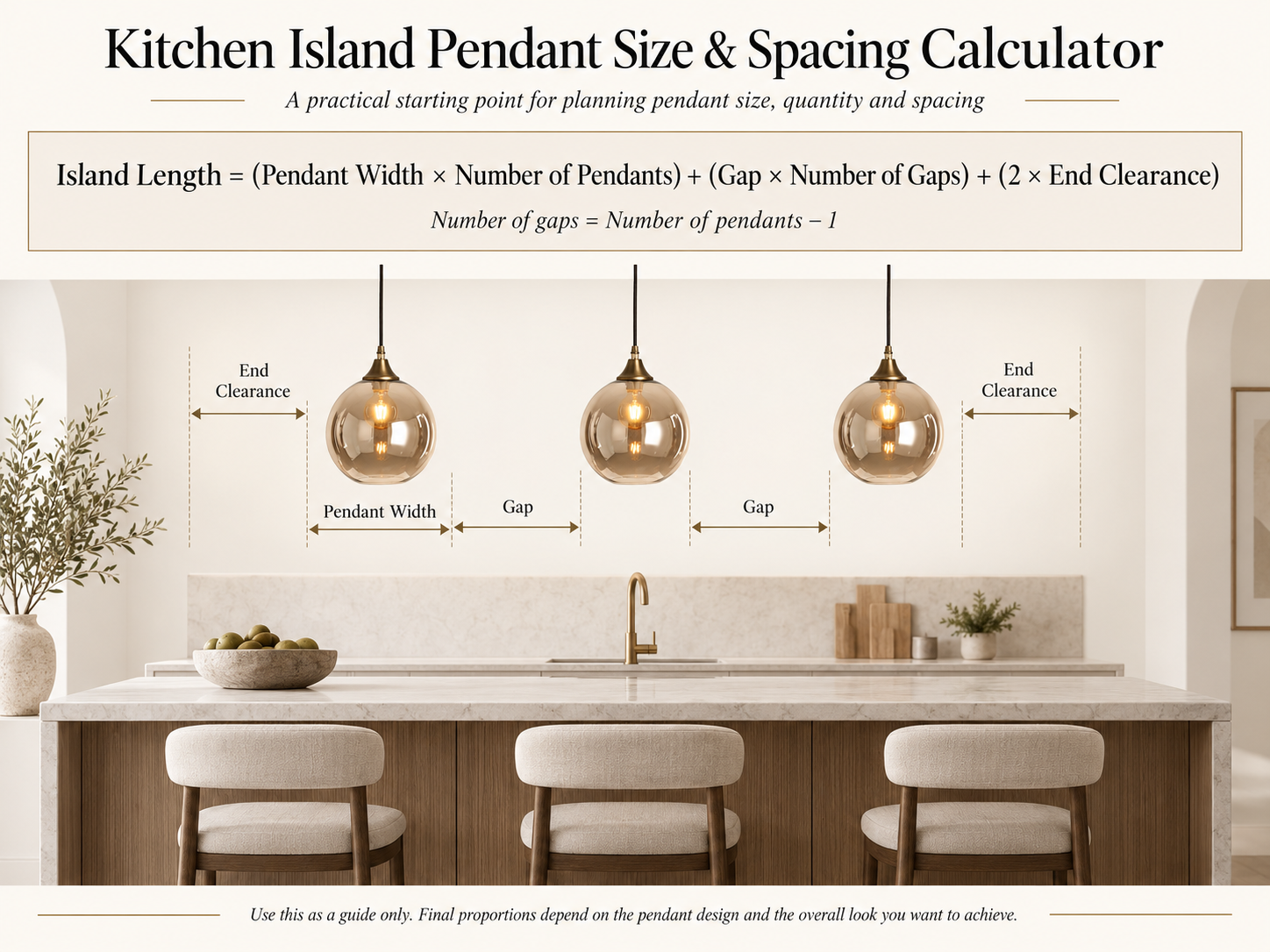
A useful starting formula is:
Island length = total pendant width + total gaps + end clearances
Or more specifically:
Island Length = (Pendant Width × Number of Pendants) + (Gap × Number of Gaps) + (2 × End Clearance)
Where:
Number of gaps = Number of pendants − 1
This gives you a quick way to check whether a particular layout will fit comfortably across your island.
Example: 3 x 25cm Pendants
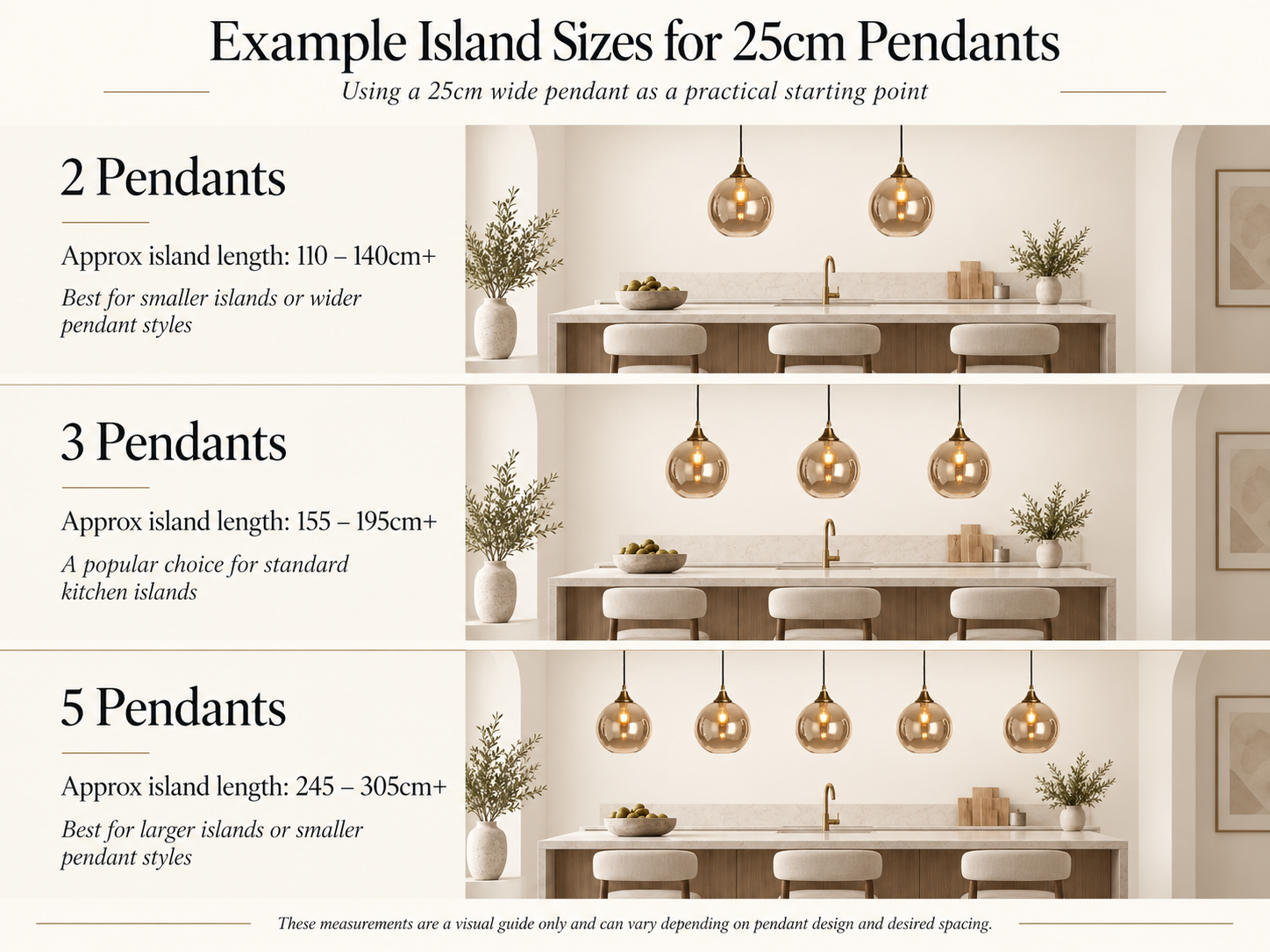
If you are using three pendants that are each 25cm wide, and you allow:
25cm between each pendant
25cm clearance at each end
The calculation is:
(25 × 3) + (25 × 2) + (25 × 2)
= 75 + 50 + 50
= 175cm
So an island around 175cm long would be a sensible starting point for three 25cm pendants using those proportions.
Example Island Sizes for 25cm Pendants
Using a 25cm wide pendant as a guide:
2 pendants — usually suit islands around 110–140cm+
3 pendants — usually suit islands around 155–195cm+
5 pendants — usually suit islands around 245–305cm+
These are not fixed rules. They are a useful visual starting point based on leaving breathing room between the pendants and at the ends of the island.
How Much Space Should Be Left Between Pendants?
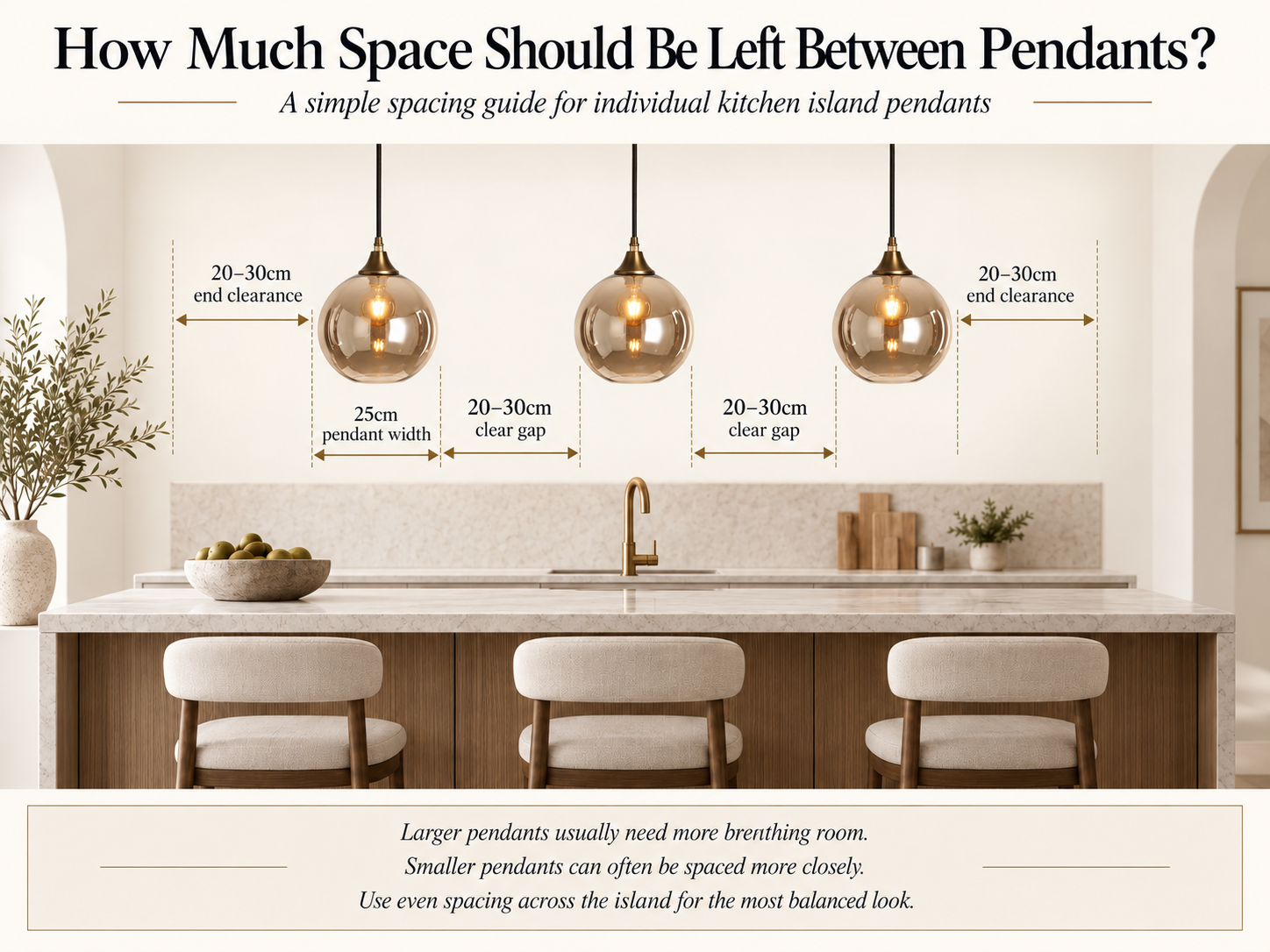
For many small and medium pendant lights, allowing around 20–30cm of clear space between the shades is a useful starting point.
Larger pendants often look better with more breathing room, while smaller fittings can usually sit closer together.
As a rough guide:
Small pendants — around 15–20cm wide
Medium pendants — around 20–30cm wide
Large pendants — around 30–40cm+
The larger the shade, the more space it will usually need.
How Much Space Should Be Left at Each End?
Try to leave around 20–30cm between the outside edge of the end pendant and the end of the island.
This helps the arrangement feel balanced and avoids the fittings looking cramped against the island edges.
If the pendant is especially large or visually heavy, allowing more space can often improve the overall look.
Working Backwards From Your Island Size
If you already know the length of your island, you can work backwards to see whether a layout is likely to work.
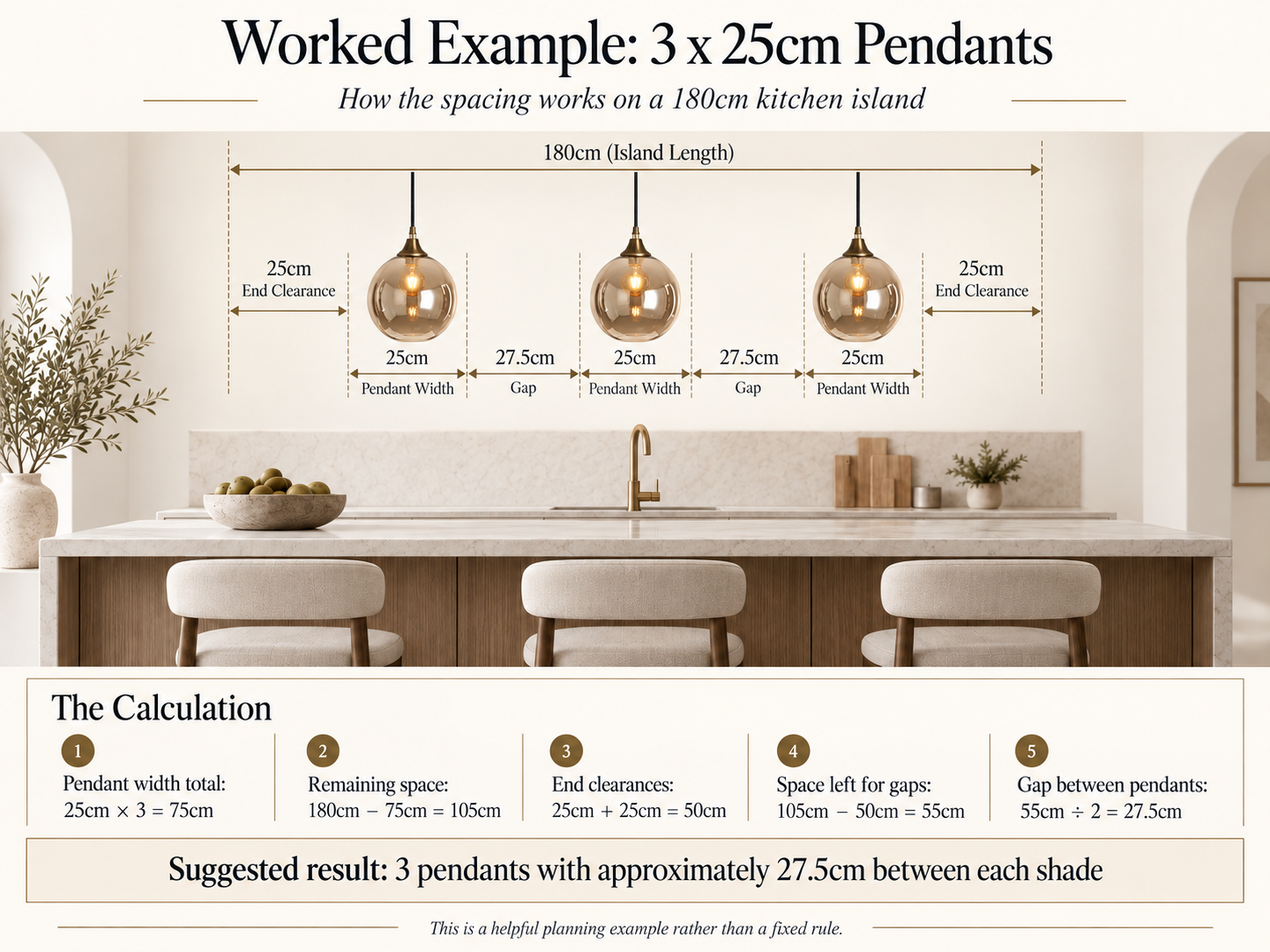
For example, imagine your island is 180cm long and you want to use three pendants that are each 25cm wide.
Total pendant width:
25cm × 3 = 75cm
Space remaining:
180cm − 75cm = 105cm
If you leave 25cm at each end:
105cm − 50cm = 55cm
There are two spaces between three pendants:
55cm ÷ 2 = 27.5cm
So the clear gap between each pendant would be approximately 27.5cm, which would give a nicely balanced starting layout.
2 Pendants
Two pendants can work beautifully over a smaller island or where the pendant itself has a larger shade.
The key is to keep the pair symmetrical and make sure there is enough breathing room at both ends.
For wider or heavier pendant styles, two fittings can often look more balanced than trying to fit three into the same space.
3 Pendants
Three pendants are one of the most versatile layouts for a standard kitchen island.
The middle pendant can be positioned over the centre of the island, with the two outer fittings placed at equal distances either side.
This makes it easy to create a balanced, symmetrical arrangement.
5 Pendants
Five pendants work best over larger islands, particularly where the individual fittings are relatively small.
Because there are more lights, the spacing naturally becomes tighter.
The key is to maintain even gaps and make sure the end pendants still have enough clearance from the island edges.
Think About Visual Weight, Not Just Width
Two pendants that are both 25cm wide can look very different depending on their design.
A clear glass pendant may feel lighter and less dominant than a solid metal shade of exactly the same size.
When choosing your layout, consider:
pendant width
pendant height
glass or solid material
colour and finish
how visually heavy the fitting feels
ceiling height
the overall scale of the kitchen
This is why the calculator should be used as a guide rather than a strict rule.
A Simple Rule to Remember
When planning individual pendants over a kitchen island:
Start with the island length.
Choose the pendant size.
Allow breathing room between each fitting.
Leave space at both ends.
Then check that the whole arrangement looks balanced.
The best layout is the one that feels properly proportioned to the island rather than simply fitting in the maximum number of pendants possible.
Still Unsure?
If you are unsure which pendant size or quantity will work best, send us:
your island length
your island width
the pendant you are considering
and we’ll be happy to help you work out a suitable arrangement.